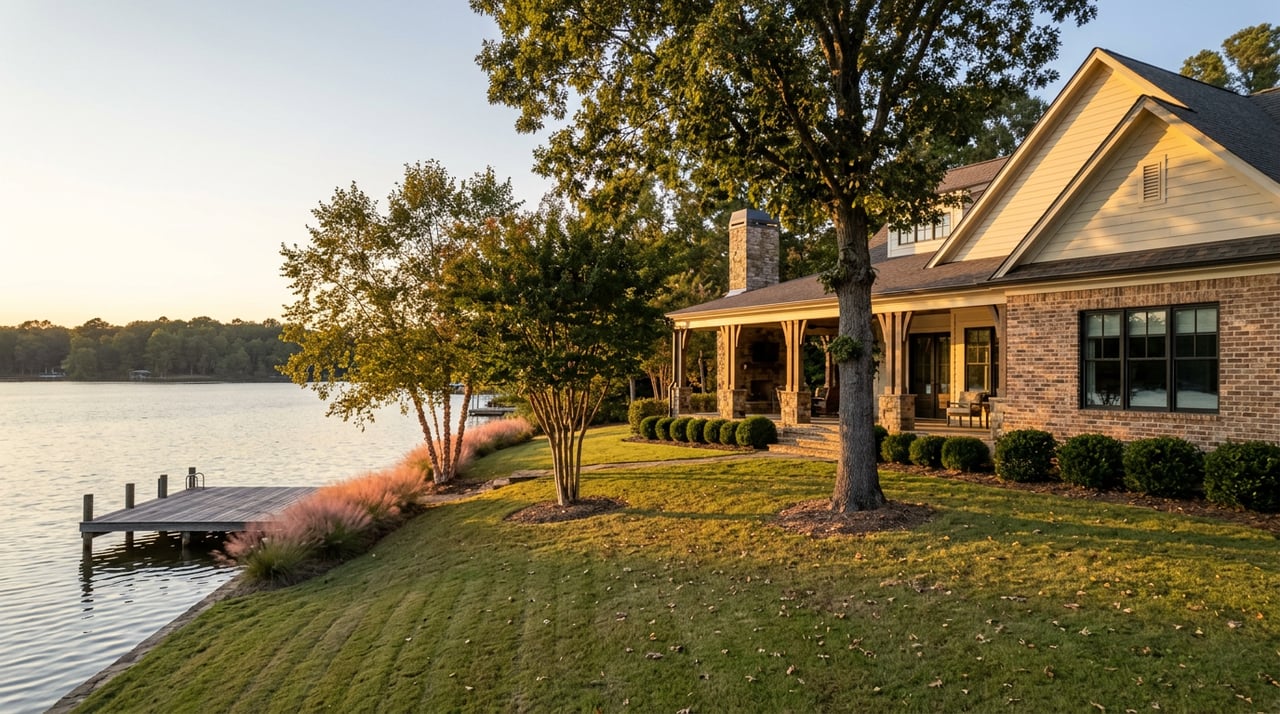
On paper, a private dock reads like part of the property. It shows up in listing photos, gets described as a selling point, sometimes even gets referenced in a community's covenants. None of that means it belongs to you when you close.
In Gainesville's Lake Lanier neighborhoods, the U.S. Army Corps of Engineers describes the dock permit tied to a waterfront lot as a federal license, not a deeded right. The moment a deed changes hands, the permit does not automatically transfer. The buyer doesn't inherit it. The buyer submits a Change of Owner application to the U.S. Army Corps of Engineers.
For buyers comparing Gainesville's lake communities, this distinction is important to understand before making an offer. And it matters more here than the square footage, the view, or even the sale price, because the permit itself is the scarce asset. Private dock permits are capped, and the Corps stopped issuing new permits after reaching the limit.
Why the Cap, Not the Coastline, Sets the Ceiling
Lake Lanier's Shoreline Management Plan capped private dock permits at 10,615 lake-wide, a limit the Corps reached and stopped issuing new permits against, confirmed by Forsyth County News reporting on the policy shift and the waitlist that followed. A lottery distributed the last available permits in 2009. Since then, the program has run on a first-come, first-served basis for any permits that return to circulation, which happens rarely and mostly through revocation or abandonment.
That means a home with a valid dock permit isn't just waterfront. It's holding a fixed, non-renewable slot in a system that hasn't grown in over a decade. According to the U.S. Army Corps of Engineers' Lake Lanier zoning map, a lake-access lot two doors down, with the same square footage and the same view, may never legally support a private dock at all. The shoreline in front of it might be classified Protected rather than Limited Development.
For a buyer moving up into Gainesville's lake market, this is the number that actually explains why two nearly identical listings can carry very different price tags. It isn't the dock itself. It's whether the paperwork attached to that dock can legally exist at all.
What Happens the Day You Close
The Change of Owner process is an important part of the purchase to understand. A dock permit is a revocable USACE license attached to a single residential parcel, and the Corps reviews the change of owner. Once the sale records, the permit does not automatically transfer to the buyer. The buyer has to complete a formal Change of Owner submission to the Corps, and that process typically runs six to eight weeks from the day the paperwork goes in.
The submission isn't a formality. The Corps' Change of Owner instructions call for a copy of the recorded deed, a site drawing showing the dock's position relative to the property boundary, and, if the dock has electrical service, an Exhibit C certification completed by a licensed electrician. The Corps' Exhibit C requirements state that the wiring must meet National Electric Code standards. If any of that is missing or outdated, the timeline stretches.
These details are part of due diligence, where a buyer can review the dock and its paperwork before proceeding.
How Gainesville's Named Communities Handle Water Access
Gainesville's lake neighborhoods don't all handle water access the same way, and the differences affect how residents reach the water.
| Community | How Residents Reach the Water | What a Buyer Should Verify |
|---|---|---|
| Harbour Point | Many waterfront lots carry individual USACE-permitted docks, alongside yacht club slip privileges | Whether the specific lot's permit is current, not just whether the home has yacht club access |
| Marina Bay | Built around a private marina, with slips managed through the HOA rather than lot-by-lot docks | Whether a slip is guaranteed with the home or assigned from a waitlist |
| Chattahoochee Country Club | A shared community dock tied to club membership | Whether club dues and dock access are billed separately from HOA fees |
| Cresswind at Lake Lanier | Marina access bundled into an annual HOA fee that also covers landscaping and common areas | What the fee actually includes before assuming boat storage is part of it |
| Dockside Cove | A gated community organized around its own private marina | Whether marina slips are deeded to the unit or leased annually |
The pattern across all five: the closer a community gets to guaranteeing individual, permitted dock access, the more the dock permit itself becomes the asset changing hands, not just the house sitting behind it.
Read the Water Before You Read the Listing
There's a seasonal wrinkle worth knowing if you're touring lake homes in Gainesville this month. Lake Lanier follows a predictable annual cycle. The Corps lowers the lake through late fall and winter to create flood storage, spring rain brings it back toward full pool by around June 1, and by September the drawdown for winter begins again. As of mid-September 2026, the lake sits several feet below the 1,071-foot full pool elevation.
That gap matters for more than boating comfort. A dock permit guarantees the legal right to have a structure at a given location. It says nothing about whether that structure currently reaches usable water. A dock photographed in June at full pool can sit over mud by September. If you're touring a listing this fall, ask to see the dock at current water level, not the marketing photo taken during peak season. What you're buying is the permit. What you're using is the water level on closing day.
Before You Write the Offer
Dock permit verification belongs in the due diligence conversation before an offer goes in, not after. A buyer working through a Gainesville lake purchase should expect to request, at minimum:
- The current USACE permit number and a copy of the permit itself
- Confirmation that the permit is in the seller's name and matches the recorded deed
- A current Exhibit C electrical certification, if the dock has power
- Written confirmation of no open deficiencies or violations on file with the Corps
- A basic site drawing showing the dock's position relative to the shoreline boundary
If a seller can't produce these documents quickly, that's not automatically a dealbreaker. It's a signal to verify independently before the inspection period starts working against you.
FAQ
Can a lake-access lot in Gainesville ever get a dock added later? Only if the shoreline in front of it is classified Limited Development by the Corps and a permit returns to circulation on a first-come, first-served basis. Given that the lake-wide cap has been fully allocated for years, that's rare enough that it shouldn't factor into a purchase decision.
If the seller has a valid permit, does it transfer to me automatically at closing? No. The permit does not transfer automatically when the deed changes hands. The buyer has to submit a Change of Owner application to the Corps, a process that typically takes six to eight weeks.
Does a low water level mean my dock permit is at risk? Not directly. But a low year is the right time to check whether the dock you're buying actually reaches water you can use, not just water you're licensed to build on.
If you're comparing Gainesville's lake communities and want a straight read on which listings have current dock permits and which don't, that's a conversation worth having before you tour. Lucia Brooks-Towe has spent nearly three decades working North Georgia real estate, dock permits included. Let's Connect.
This article is general information, not legal, tax or financial advice. Consult a qualified professional about your situation.